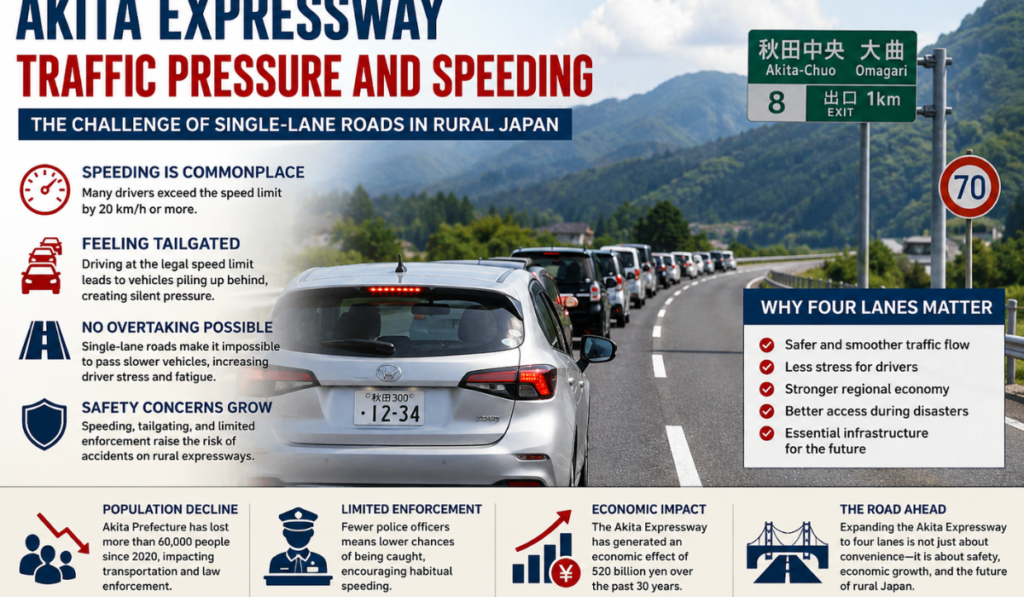
The Growing Stress of Driving on the Akita Expressway
For many residents of Akita Prefecture the dream of expanding the Akita Expressway into a four lane highway has existed for decades. While the expressway plays a critical role in transportation and economic development many sections still operate with only one lane in each direction. This limited road structure has created serious concerns about driver stress speeding culture and road safety.
As public transportation services continue to shrink in rural Japan private vehicles remain the primary method of transportation for people living across the vast prefecture. However the combination of declining population long travel distances and narrow expressway infrastructure has produced a unique driving environment where excessive speeding often feels normalized.
Why Single Lane Expressways Create Psychological Pressure
Driving on a single lane expressway may sound manageable at first but the experience can quickly become mentally exhausting. Many drivers traveling at the legal speed limit of 70 to 80 km/h often notice vehicles rapidly piling up behind them. Since overtaking is impossible on these stretches even cautious drivers begin to feel intense pressure from surrounding traffic.
The situation becomes even more stressful when the road temporarily expands into two lanes. Drivers who were previously stuck behind slower vehicles suddenly accelerate and pass aggressively often at speeds far above the limit. For newcomers to Akita this creates the impression that speeding by 20 km/h or more is almost routine behavior.
This silent tailgating pressure has become one of the defining characteristics of driving in the region. Unlike direct road rage or reckless horn use the pressure is psychological. Drivers feel constantly pushed to move faster simply because of the flow of traffic around them.
Speeding Culture and Regional Driving Habits
Several regional factors appear to contribute to the high speed driving culture found on the Akita Expressway.
Spacious Roads Encourage Faster Driving
Compared to highly populated urban areas in Japan Akita has wider roads and less traffic congestion. Long stretches of open road naturally tempt drivers to increase speed especially when traffic lights and intersections are limited.
Over time maintaining higher speeds becomes habitual. Many drivers no longer perceive traveling above the speed limit as dangerous because the roads often appear empty and easy to navigate.
Limited Police Enforcement
Population decline has affected nearly every aspect of life in Akita including law enforcement resources. As the number of residents decreases maintaining large scale traffic patrol operations becomes increasingly difficult.
Some drivers believe the chances of being stopped for speeding are relatively low compared to larger metropolitan areas. This perception may contribute to relaxed attitudes toward traffic regulations and encourage routine speeding on expressways.
Car Culture in Rural Japan
Vehicle ownership remains deeply connected to daily life and personal status in many rural parts of Japan. Residents often purchase powerful or luxury vehicles capable of high speed driving. With fewer traffic restrictions and open roads drivers can easily enjoy faster acceleration and smoother cruising speeds.
Even a slight increase in pressure on the accelerator can quickly push vehicles beyond legal speed limits on single lane expressways.
The Major Difference Between One Lane and Two
The contrast between one lane and two lane expressways becomes especially noticeable when drivers transition from the Akita Expressway to larger highways such as the Tohoku Expressway.
On roads with two lanes in each direction drivers have the freedom to maintain their preferred speed without creating long traffic queues behind them. Faster vehicles can safely pass slower cars without forcing anyone into uncomfortable driving situations.
Many motorists describe this transition as an immediate feeling of relief. The stress disappears traffic flows more naturally and drivers no longer feel trapped between maintaining safety and keeping up with aggressive traffic behavior.
This dramatic difference highlights why many local residents strongly support the long awaited four lane expansion project.
Akita Expressway Supports the Regional Economy
Beyond transportation convenience the Akita Expressway serves as a vital economic artery for the entire prefecture. Over the past three decades since its opening the highway has generated an estimated economic impact of approximately 520 billion yen.
The expressway supports
- Regional tourism
- Agricultural transportation
- Logistics and freight movement
- Emergency disaster response
- Access to medical services
- Business development in rural communities
During natural disasters and emergencies the road has also functioned as a critical supply route for delivering aid and essential goods to affected areas.
For this reason expanding the highway is not viewed merely as a comfort upgrade. Many residents see it as an investment in the long term survival and competitiveness of the region.
Population Decline Is Reshaping Infrastructure Needs
Like many rural areas in Japan Akita faces severe population decline. Since 2020 alone the prefecture’s population has dropped by more than 60000 people. This demographic shift creates difficult questions about how governments should maintain and improve infrastructure while tax revenues continue to shrink.
At the same time declining public transportation options mean residents rely even more heavily on personal vehicles. This creates a paradox where roads become increasingly essential even as the population decreases.
The challenge for policymakers is balancing infrastructure investment with shrinking financial resources. Expanding expressways into four lane highways requires enormous funding but failing to improve road safety and transportation efficiency may accelerate regional decline even further.
Road Safety Concerns Continue to Grow
The normalization of speeding on single lane expressways raises serious safety concerns. When most vehicles travel significantly above the speed limit drivers who follow traffic laws may feel isolated or pressured into unsafe decisions.
This environment can increase risks such as
- Tailgating accidents
- Dangerous overtaking attempts
- Driver fatigue
- Stress related mistakes
- Reduced reaction times during emergencies
Long periods of psychological tension behind the wheel can also double mental exhaustion for drivers traveling across rural regions.
Improving lane capacity could significantly reduce these risks by allowing smoother traffic flow and reducing frustration among motorists.
The Future of the Akita Expressway
For the people of Akita Prefecture the four lane expansion of the Akita Expressway represents far more than a transportation project. It symbolizes safety economic stability and hope for regional sustainability in an era of declining population.
As Japan continues to confront demographic challenges Akita’s road infrastructure dilemma may become increasingly relevant across other rural prefectures as well. The debate highlights an important national question how can aging and shrinking communities continue to maintain the transportation systems they depend on every day
The answer may ultimately determine the future survival of many regional economies throughout Japan.