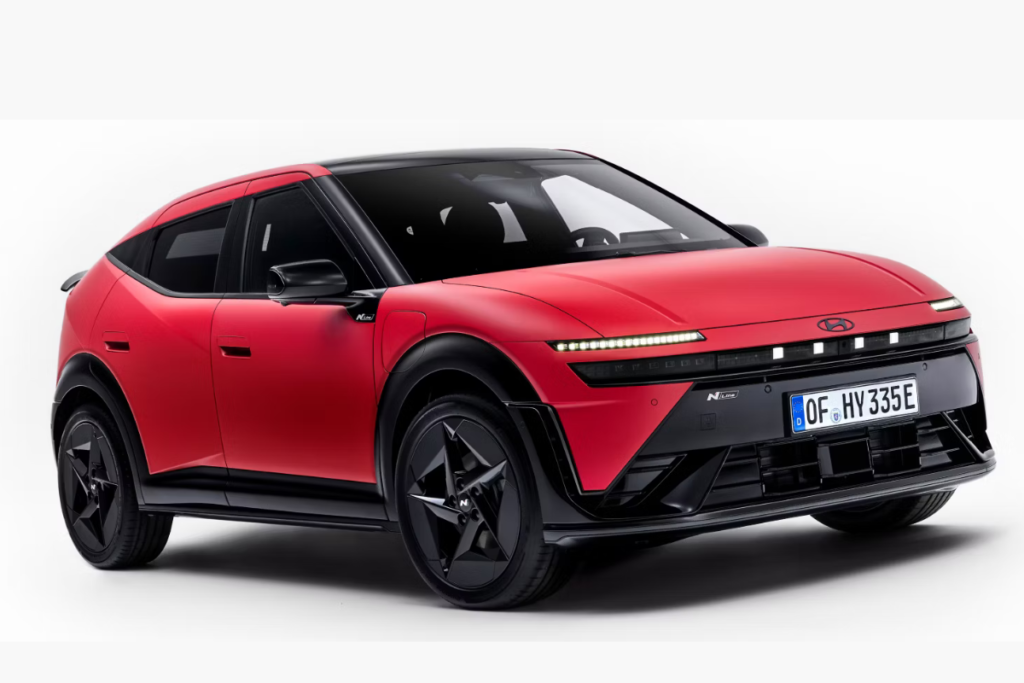
Hyundai has officially pulled the covers off the IONIQ 3, its newest fully electric compact model aimed squarely at European drivers. This is not a concept car or a far-off promise. The IONIQ 3 is a production-ready vehicle designed from the ground up to make electric driving feel natural, comfortable, and genuinely practical for the kind of daily use that most people in Europe actually live. It slots into a segment that has been growing rapidly, and Hyundai is clearly betting that this particular car can hold its own against some well-established competition.
WHAT THE IONIQ 3 IS TRYING TO DO
The brief Hyundai gave itself for the IONIQ 3 is worth understanding before diving into the details. The company wanted to bring the design quality and technology that defines the broader IONIQ brand into a more accessible price bracket, reaching a wider base of European customers who may have found the IONIQ 5 or IONIQ 6 either too large or too expensive for their needs. Xavier Martinet, President and CEO of Hyundai Motor Europe, was direct about this in the launch statement.
“With the IONIQ 3, we are making the distinctive design, driving pleasure, and advanced features of the IONIQ brand accessible to a wider customer base across Europe,” Martinet said. “The IONIQ 3 is tailored to the needs of European customers, combining segment-leading range and aerodynamics with exceptional space, comfort, and practicality.”
That is a confident claim. Whether the car delivers on it depends on the specifics, and the specifics are worth going through carefully.
THE DESIGN: ART OF STEEL IN A SMALLER PACKAGE
Hyundai is applying its “Art of Steel” design language to the IONIQ 3, which means the same philosophy that shapes the IONIQ 5 and 6 now informs this compact model. The idea behind Art of Steel is relatively straightforward: surfaces are reduced to a small number of carefully considered volumes, drawing inspiration from the tension and clarity of steel manufacturing. The result is a car that looks deliberate and precise rather than busy or decorated.
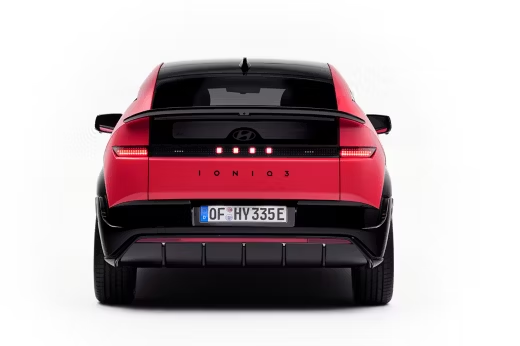
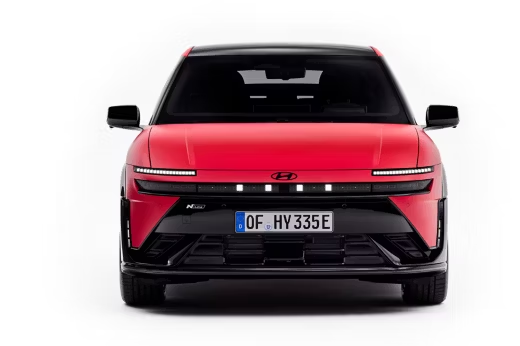
The body style Hyundai is calling the “Aero Hatch” is new to the lineup. The silhouette was designed with two goals held simultaneously: aerodynamic efficiency and interior space. The front end sits low and flows into a roofline that runs flat across the full length of both front and rear passenger areas before sloping down toward the rear and merging into an integrated spoiler. That profile is what allows the car to achieve a drag coefficient of 0.263, which is genuinely competitive for this class, while also creating the headroom that makes the rear seats feel more generous than the compact exterior dimensions might suggest.
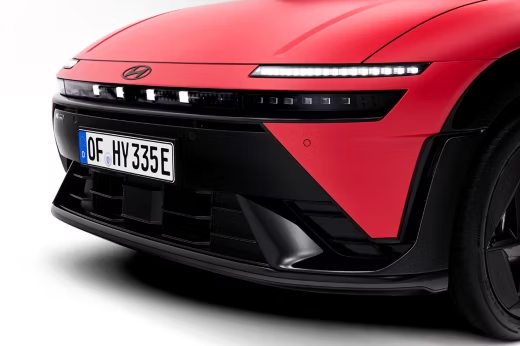
Pixel lighting carries over from the rest of the IONIQ family, as do the four central dots that reference the letter H in Morse code. These are the visual cues that tie the IONIQ 3 to its siblings without making it look like a reduced or lesser version of them. Buyers can choose from eight exterior colors at launch, including Atlas White Solid, Phantom Black Pearl, Lumen Gray Pearl, Aurora Gray Pearl, Vibrant Blue Pearl, Ice Blue Pearl, Fierce Red Solid, and Fierce Red Matte. Wheel sizes run from 16 to 19 inches depending on trim, and an N Line variant adds sportier design details and exclusive touches for drivers who want a more dynamic look.
PLATFORM AND POWERTRAIN
The IONIQ 3 is built on the Hyundai Motor Group’s Electric-Global Modular Platform, known as E-GMP. This is the same architecture that underpins the IONIQ 5 and IONIQ 6, and its use here matters for a few reasons. E-GMP with a 400-volt architecture provides a solid foundation for efficiency and everyday usability. It is a proven system rather than a new and untested approach, which gives Hyundai a head start on reliability and component maturity.
Two battery options are available. The Standard Range battery carries 42.2 kWh of capacity and is projected to deliver a WLTP range of 344 kilometers. The Long Range battery holds 61 kWh and is projected to achieve 496 kilometers of range on the WLTP cycle. The Long Range figure, if it holds up in real-world European driving conditions, would represent a genuinely strong result for this segment and is one of the key claims Hyundai is making for the car.
Power comes from a front-wheel drive setup. The Standard Range model produces 99.5 kW, equivalent to 135 horsepower, while the Long Range model delivers 107.8 kW, or 147 horsepower. Both versions reach a top speed of 170 km/h and accelerate from zero to 100 km/h in either 9.0 or 9.6 seconds depending on the variant. Maximum torque is 250 Nm across both configurations.
Charging performance is one of the areas where the IONIQ 3 makes a clear bid for everyday convenience. DC fast charging tops out at 119 kW on the Standard Range version and 110 kW on the Long Range, with both variants capable of charging from 10 to 80 percent in approximately 29 to 30 minutes under optimal conditions. AC charging is available at 11 kW as standard, with 22 kW as an optional upgrade for those who have access to faster home or public AC infrastructure.
INTERIOR: THE FURNISHED SPACE CONCEPT
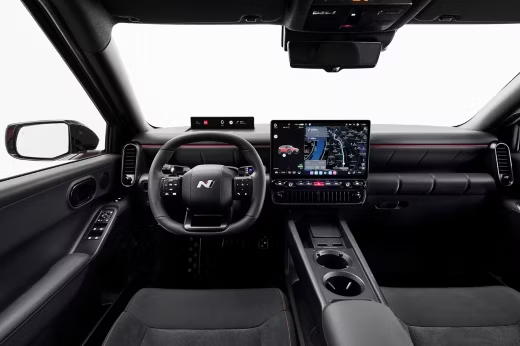
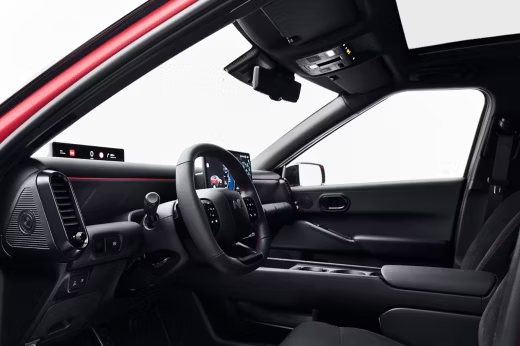
Inside, Hyundai has organized the IONIQ 3’s cabin around what it calls the Furnished Space concept. The idea is to treat the interior like a room rather than a cockpit, arranging components the way furniture is arranged in a living space to create warmth and intuitive usability rather than a driver-centric, control-heavy environment.
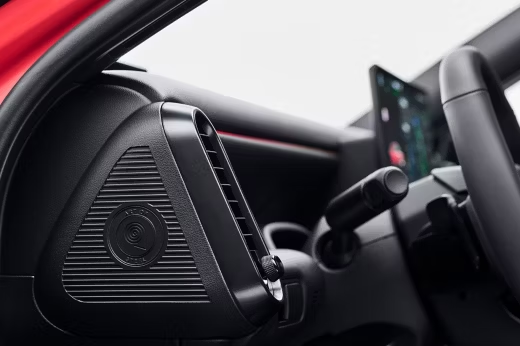
The flat floor, made possible by the E-GMP platform, contributes meaningfully to this feeling. There is no transmission tunnel or elevated center section breaking up the floor space, which opens up legroom for all five occupants and makes the rear bench genuinely usable for three adults. The wheelbase of 2,680 mm supports the long interior proportions that make this possible despite the car’s compact 4,155 mm length in its entry-level form and 4,170 mm in the N Line.
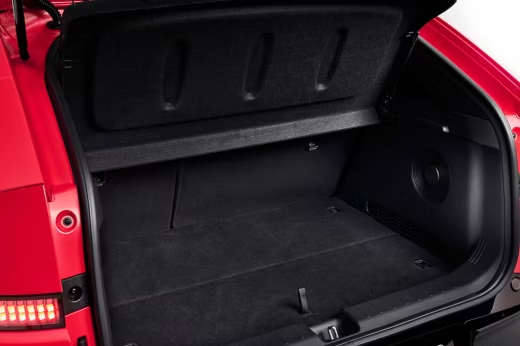
Boot capacity comes in at 441 liters in total, made up of 322 liters in the main boot and an additional 119 liters in the Megabox, which is a concealed storage space integrated beneath the boot floor. For a compact electric vehicle, that is a competitive figure and addresses one of the more practical concerns buyers in this segment typically raise.
Seat options include Relaxation Seats on higher trim levels, along with heated and ventilated seats. The material choices reflect a considered approach: Hyundai describes the textiles as inspired by 1970s Italian furniture design, incorporating recycled and bio-based materials alongside more conventional options. Interior color choices include Black, Beige and Grey, Blue and Grey, and a Black with red accents option exclusive to the N Line. A BOSE premium sound system, dual-zone automatic climate control, and LED ambient lighting round out the cabin appointments. Hyundai has also incorporated what it describes as Easter egg details throughout the interior, small design moments intended to reward attention and create a sense of discovery.
PLEOS CONNECT: A NEW INFOTAINMENT SYSTEM FOR EUROPE
The IONIQ 3 is the first European Hyundai model to feature the Pleos Connect infotainment system, and that introduction alone makes this car notable within the company’s European lineup. Pleos Connect runs on Android Automotive OS, which means it is fully integrated with Google services rather than relying on a phone-mirroring approach. Navigation, apps, and voice assistance all operate natively within the car’s system.
Display options are a 12.9-inch or 14.6-inch screen depending on trim level, offering clear access to vehicle functions, navigation, and connectivity features. Hyundai Digital Key 2 allows keyless entry through a smartphone or a compatible wearable device. Plug and Charge capability simplifies the public charging process by allowing the car to authenticate automatically at compatible stations without requiring a card or app interaction. An integrated EV route planner helps manage longer journeys by accounting for charging stops.
Vehicle-to-load functionality is included, allowing the IONIQ 3 to act as a power source for electrical devices both inside and outside the car. This feature has become increasingly valued by buyers who use their cars for outdoor activities, remote work, or simply as a backup power source at home.
DRIVER ASSISTANCE: SMARTSENSE ON THE COMPACT
Hyundai’s SmartSense driver assistance suite makes its way into the IONIQ 3 in a notably complete form. Highway Assist 2.0 includes hand detection, which monitors whether the driver maintains appropriate contact with the steering wheel during assisted highway driving. Remote Park Assist 2.0 adds a memory function, allowing the system to record and replay a specific parking maneuver, as well as a monitor display that shows the blind spot area during the process.
A 360-degree camera system supports low-speed maneuvering, and a dedicated blind spot monitoring display is included. Seven airbags are standard across the range. Projection LED headlights with an Intelligent Front Lighting System adapt the beam pattern to road conditions, and dynamic welcome lighting activates when approaching the car.
BUILT IN EUROPE FOR EUROPEAN BUYERS
Hyundai has made a point of emphasizing the IONIQ 3’s European development and production credentials. The car was developed at the Hyundai Motor Europe Technical Center in Rüsselsheim, Germany, which serves as the company’s primary engineering and design hub for the European market. Production takes place at the Hyundai Motor Türkiye plant in Izmit, Turkey. Both decisions reflect Hyundai’s stated commitment to local development and manufacturing for the European region, which carries relevance not only for supply chain resilience but also for the car’s alignment with European regulatory and consumer expectations.
TECHNICAL SPECIFICATIONS AT A GLANCE
Dimensions:
Length: 4,155 mm (entry-level) / 4,170 mm (N Line)
Width: 1,800 mm
Height: 1,505 mm
Wheelbase: 2,680 mm
Weight: 1,550 to 1,580 kg
Battery and Charging:
Standard Range battery capacity: 42.2 kWh
Long Range battery capacity: 61 kWh
DC charging: 119 kW (Standard Range) / 110 kW (Long Range), 10 to 80 percent in approximately 29 to 30 minutes
AC charging: 11 kW standard / 22 kW optional
Performance:
Top speed: 170 km/h
0 to 100 km/h: 9.0 seconds (Long Range) / 9.6 seconds (Standard Range)
Engine output: 107.8 kW / 147 hp (Long Range) and 99.5 kW / 135 hp (Standard Range)
Maximum torque: 250 Nm
Drag coefficient: 0.263
Range (WLTP):
Standard Range: 344 km
Long Range: 496 km
Boot Capacity: 441 liters total (322 liters main boot plus 119 liters Megabox)
Tire options: 205/65 R16 / 215/55 R17 / 215/50 R18 / 225/45 R19
Electricity consumption: 14.2 to 13.8 kWh per 100 km (combined WLTP)
CO2 emissions: 0 g/km
Exterior colors at launch: Atlas White Solid, Phantom Black Pearl, Lumen Gray Pearl, Aurora Gray Pearl, Vibrant Blue Pearl, Ice Blue Pearl, Fierce Red Solid, Fierce Red Matte
Interior colors: Black, Beige/Grey, Blue/Grey, Black with red accents (N Line exclusive)
AVAILABILITY
The IONIQ 3 has not yet gone on sale. Homologation and fuel consumption testing for the German market version will take place immediately before the official market launch. Pricing and specific market availability dates have not been announced at this stage. Hyundai has confirmed the car is intended for European customers, with the development and production locations reflecting that regional focus.
FREQUENTLY ASKED QUESTIONS
Q1. What is the Hyundai IONIQ 3 and who is it aimed at?
The IONIQ 3 is Hyundai’s newest fully electric compact hatchback, designed specifically for European customers. It sits below the IONIQ 5 and IONIQ 6 in the lineup in terms of size and price positioning, and is intended to bring IONIQ brand design and technology to buyers who want an electric vehicle that is practical and comfortable for everyday urban and suburban use without the larger footprint or price of the bigger models.
Q2. What is the IONIQ 3’s range and how does it compare within the segment?
The Standard Range variant is projected to achieve 344 km on the WLTP cycle, while the Long Range version is projected at 496 km. The Long Range figure is one of the stronger results in the compact electric vehicle class, though real-world performance will depend on driving style, conditions, and temperature. Hyundai is positioning the Long Range range figure as class-leading for this segment.
Q3. How fast does the IONIQ 3 charge?
The IONIQ 3 supports DC fast charging at up to 119 kW on the Standard Range version and 110 kW on the Long Range version. Both can charge from 10 to 80 percent in approximately 29 to 30 minutes under optimal conditions. AC charging is available at 11 kW as standard, with 22 kW available as an option for faster home or destination charging.
Q4. What is the Pleos Connect infotainment system?
Pleos Connect is a new infotainment system based on Android Automotive OS, making its European debut in the IONIQ 3. It runs Google services natively, meaning navigation, apps, and voice control operate within the car’s own system rather than mirroring a phone. Screen sizes of 12.9 and 14.6 inches are available depending on trim, and the system includes Hyundai Digital Key 2, Plug and Charge capability, an integrated EV route planner, and vehicle-to-load functionality.
Q5. How much interior space does the IONIQ 3 offer given its compact exterior?
Despite a length of just 4,155 mm, the IONIQ 3 offers meaningful interior space thanks to the flat floor and long 2,680 mm wheelbase enabled by the E-GMP platform. Rear passengers benefit from notable headroom and legroom, and Hyundai says three adults can sit comfortably in the back. Total boot capacity is 441 liters, including 322 liters of conventional boot space and 119 liters in the Megabox storage compartment beneath the boot floor.
Q6. Where is the IONIQ 3 developed and manufactured?
The IONIQ 3 was developed at the Hyundai Motor Europe Technical Center in Rüsselsheim, Germany. It is manufactured at the Hyundai Motor Türkiye plant in Izmit, Turkey. Both locations reflect Hyundai’s emphasis on European development and local production for this market.
Q7. Is the IONIQ 3 available to buy now?
No. At the time of the unveiling, the IONIQ 3 is not yet available for sale. Homologation and fuel consumption testing for the German market version will take place before the market launch. Hyundai has not announced specific pricing or launch dates for individual European markets.
Q8. What driver assistance features does the IONIQ 3 include?
The IONIQ 3 comes with Hyundai’s SmartSense driver assistance suite, which includes Highway Assist 2.0 with hand detection, Remote Park Assist 2.0 with memory function and a monitor display for blind spot monitoring, a 360-degree camera, and seven standard airbags. Projection LED headlights with an Intelligent Front Lighting System and dynamic welcome lighting are also included to improve visibility and safety during everyday driving.
Pingback: Ford's CEO Is Done Watching China From a Distance. Now He Wants to Copy It. - ev auto Industry