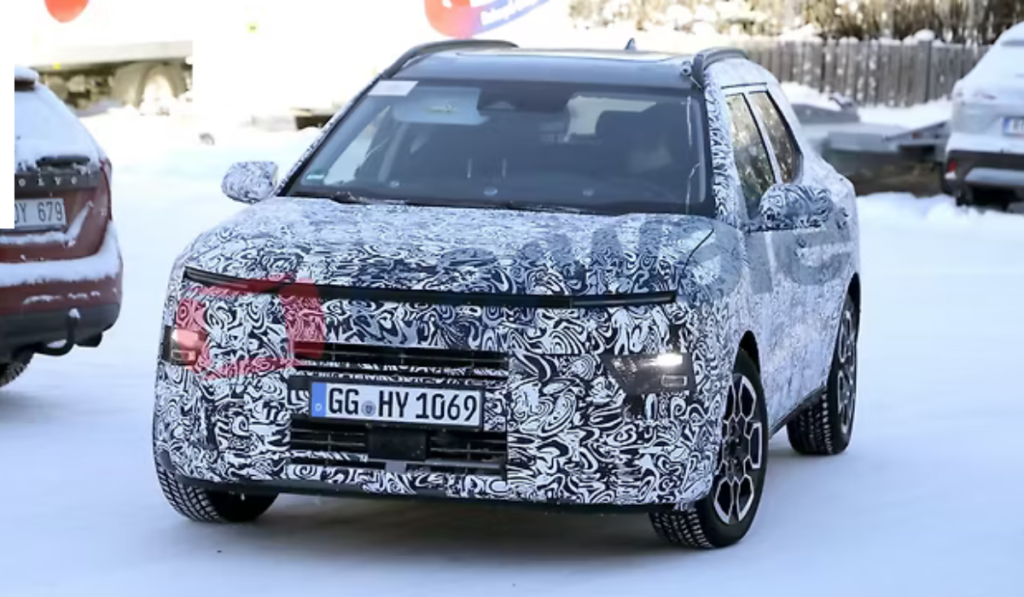
Korean carmaker confirms a new mid-size ICE SUV and a locally developed compact electric SUV as its first fresh nameplates in India in over four years, anchoring an 8–10% growth target.
CHENNAI — Hyundai Motor India has confirmed plans to launch two all-new SUVs in the Indian market in the financial year 2026-27, marking the company’s first new nameplates in the country in more than four years and forming the cornerstone of its push to reclaim ground lost to homegrown rivals Tata Motors and Mahindra.
The announcement was made during the company’s fourth-quarter earnings call following its board meeting on May 8, 2026. One of the two upcoming vehicles will be a mid-size internal combustion engine (ICE) SUV, while the second will be a locally developed compact electric SUV — both targeting what Hyundai describes as the highest-volume segments in the Indian passenger vehicle market.
Two Completely New Nameplates
Tarun Garg, Managing Director and CEO of Hyundai Motor India, told analysts that the company intends to introduce two completely new nameplates during the financial year — one debuting Hyundai’s locally developed dedicated EV in the compact SUV space, and the other expanding its presence in the ICE SUV segment.
Garg added that both launches will land in very high-volume segments and that the company is confident about the potential of the models. Hyundai is sticking with a domestic volume growth target of 8–10% for FY27.
The Mid-Size ICE SUV (Bc4i)
Internally codenamed Bc4i, the upcoming mid-size SUV is reported to be built on the i20 platform and stretch to roughly 4.18 metres in length. Industry reports indicate it will slot between the Creta and Alcazar in Hyundai’s lineup, giving the company a familiar “twin-product” strategy in one of India’s most contested segments.
The model is expected to take aim at the upcoming Maruti Suzuki Victoris rather than the smaller Fronx, with naturally aspirated petrol engines and CNG options likely to be offered. It is also widely tipped to debut Hyundai’s hybrid petrol technology in India, sitting alongside the next-generation Creta, which is scheduled to follow later in the product cycle.
The Compact Electric SUV (HE1i)
The second launch — codenamed HE1i — is a sub-four-metre electric SUV that will serve as Hyundai’s direct response to the Tata Nexon EV and its own sister product, the Kia Syros EV. The vehicle is expected to share the E-GMP (K) platform, dimensions, and powertrain configurations of the Syros EV.
Reports suggest the EV will be offered with standard and long-range battery options, delivering a real-world driving range of approximately 300 to 350 km. Features are expected to include a high-resolution infotainment system, connected-car technology, and fast charging capable of taking the battery from 10% to 80% in under an hour.
This will be Hyundai’s first locally developed compact EV — a key strategic move given the rapid growth in India’s entry-level electric segment and the company’s previous reliance on imported or higher-priced electric models.
Part of a Bigger 26-Model Roadmap
The FY27 launches are the opening act of a far larger product cycle. Hyundai has previously committed to introducing 26 new models in India by FY2030, comprising a mix of all-new nameplates, next-generation versions, facelifts, hybrids and electric vehicles. Subsequent launches in the pipeline reportedly include a new seven-seater SUV codenamed Ni1i, slated for 2027 and positioned between the Alcazar and Tucson, followed by the Hyundai Palisade in 2028.
Continue to Reading – Trump Tariff Proposal Raises Concerns for Audi’s Global Business
FY26 Numbers and Street Reaction
Alongside the product announcement, Hyundai Motor India reported consolidated FY26 revenue of ₹7,07,633 million, up 2.3% year-on-year, with profit after tax of ₹54,315 million and an EBITDA margin of 12.2%. The board recommended a final dividend of ₹21 per share.
For FY27, the company has guided for 8–10% growth in both domestic and export volumes, EBITDA margins of 11–14%, and capital expenditure of around ₹7,500 crore — a meaningful step-up reflecting capacity expansion and the cost of bringing the new SUVs and a localised EV to market.
Brokerages responded constructively. Nomura maintained a Buy rating with a target price of ₹2,407, pointing to the FY27 growth guidance, the two new SUV launches and the broader 26-model pipeline as drivers. CLSA retained an Outperform call with a revised target of ₹2,290, noting that Q4 margins came in below expectations but that management’s volume and margin guidance was credible, supported by capacity ramp-up and fresh product.
The Competitive Backdrop
Hyundai has been steadily losing ground to Tata Motors and Mahindra & Mahindra in recent years, slipping in the rankings of India’s passenger vehicle market as homegrown brands have moved aggressively in SUVs and EVs. The two FY27 launches are widely viewed as a defensive and offensive move at once — protecting the mid-size SUV segment where the Creta still anchors Hyundai’s volumes, while opening a new front in the high-growth compact EV space.
If the two new nameplates land with the right pricing and feature set, they could reset Hyundai’s growth trajectory in India. If they don’t, the company’s stated 8–10% growth target — and its broader 26-model bet — could come under pressure sooner than the Street currently expects.
Sources: CarWale, Team-BHP, India TV News, LatestLY, ScanX, Meroauto.