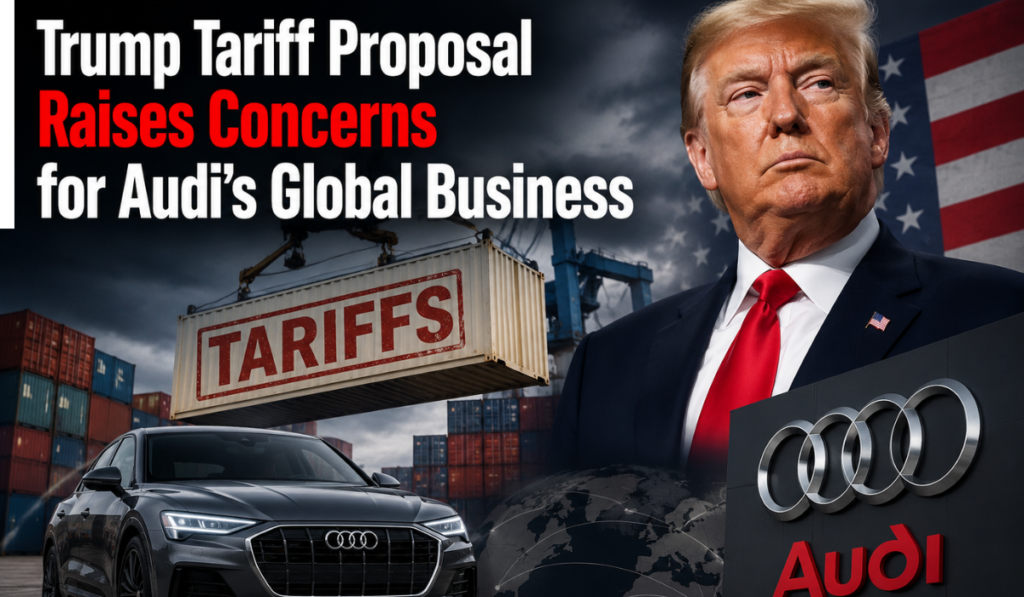
German luxury brand warns that escalating U.S. import duties on European vehicles could weigh on 2026 earnings, even as it confirms its annual forecast.
INGOLSTADT, Germany — Volkswagen AG’s premium subsidiary Audi has cautioned that U.S. President Donald Trump’s renewed push for steeper tariffs on European-built cars could materially dent its financial performance this year, throwing fresh uncertainty over an industry already grappling with softer demand and rising costs.
The German automaker reaffirmed its full-year guidance on Tuesday but conceded that the outlook does not yet incorporate two looming risks: an escalating conflict in the Middle East and the prospect of significantly higher U.S. import duties on European-made vehicles.
A Significant Burden CFO Warns
Speaking on a call with reporters, Chief Financial Officer Jürgen Rittersberger described the tariff risk as recent and not yet confirmed, noting that the company is still evaluating the potential impact but that it would clearly be significant.
Rittersberger added that if the proposed duties take effect, they would place a meaningful burden on the company, with Audi still assessing the situation.
The warning comes after Trump signaled plans to raise tariffs on imported European vehicles to 25 percent, up from the 15 percent rate currently in place — a move the administration has linked to what it sees as the European Union’s failure to comply with last year’s U.S.–EU trade framework.
Why Audi Is Especially Exposed
Unlike several of its German peers, Audi does not operate a vehicle assembly plant in the United States, making it unusually vulnerable to any escalation in import duties. Every model the brand sells in America is built abroad, including the much-anticipated Q9 SUV, which will roll off the line at Audi’s Bratislava plant in Slovakia and therefore fall within the scope of the proposed tariffs.
The Q5 — Audi’s best-selling vehicle in the U.S. — is assembled in Mexico, exposing it to a separate web of duties that industry analysts have warned could push effective tariff rates well above 50 percent on certain trims.
Rittersberger said Audi is now exploring U.S. manufacturing options in coordination with parent Volkswagen, with the Scout EV plant under construction in South Carolina viewed as one possible avenue.
Cost Cuts and Job Reductions
To shore up margins, Audi is preparing to streamline its product lineup and eliminate roughly 7,500 positions by 2029 — a restructuring effort that predates the latest tariff threats but is taking on new urgency as trade headwinds intensify.
Volkswagen Group, Audi’s parent, already absorbs an estimated 4 billion euros (about $4.7 billion) per year from existing trade barriers, a figure that could climb sharply if Washington follows through on the 25 percent levy.
Wider Industry Fallout
Audi is far from alone. Analysts at Bernstein Research estimate that an additional 10 percentage points of tariffs would cost Germany’s automakers collectively in the region of 2.6 billion euros, with manufacturers likely to pass at least part of that burden on to consumers in the form of higher sticker prices.
Matthias Schmidt, European autos market analyst at Schmidt Automotive, said that further duties would weaken Germany’s premium manufacturers and that 2026 is shaping up to be another year of profit warnings, with Audi and Porsche among the most exposed because of their lack of U.S. production capacity.
Industry observers note that Trump has repeatedly used tariff threats as leverage in trade negotiations without always following through, leaving open the possibility that the proposed 25 percent rate could be softened or delayed.
Continue Reminding Tata Nexon Pure Plus PS Becomes India’s Most Affordable Car With Panoramic Sunroof
Outlook
For now, Audi is sticking with its 2026 guidance — but executives acknowledge that the projection rests on a relatively benign trade outcome. Should Washington proceed with the higher levy, Audi has signaled it will likely absorb some of the cost, pass a portion onto buyers, and re-evaluate which models and trims make economic sense to ship to the U.S. market.
Whether the company can move quickly enough to localize production before tariffs reshape the math on its U.S. business may prove to be the defining strategic question of the year.
Sources: Bloomberg, Reuters, Automotive News, Fortune.