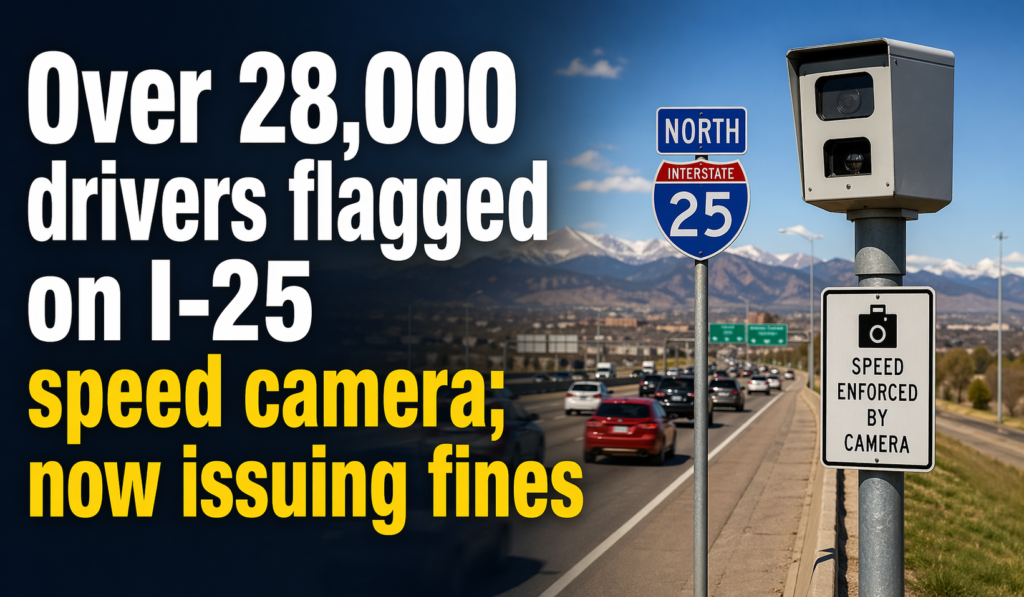
For one full month, Colorado let drivers off with a warning. Between March 1 and April 1, 2026, automated speed cameras running along Interstate 25 between Berthoud and Mead issued 28,554 warning notices to drivers caught exceeding the posted speed limit. No fines. No points. Just a letter in the mail telling each driver they had been clocked going too fast through an active construction zone. That grace period is now over. As of April 2, the cameras are issuing civil penalties, and the first batch of $75 fines is already on its way to registered vehicle owners across Colorado.
The Stretch of Road That Started It All
The section of I-25 at the center of this story runs through northern Colorado in Weld County, between the towns of Mead and Berthoud. It is not an ordinary stretch of highway right now. The Colorado Department of Transportation is in the middle of a multi-year project to add new Express Lanes in both directions along this corridor, a construction effort that is expected to run through 2028. That means years of narrowed lanes, absent shoulders, shifted traffic patterns, and workers operating in close proximity to moving vehicles every single day.
The roadway is constrained in ways that make speeding genuinely dangerous rather than merely technically illegal. Benjamin Acimovic, a CDOT manager overseeing the speed enforcement program, described the situation plainly. “When you have a high volume of traffic, and you see a constrained environment, the margin for error gets very small,” he said. “That’s true for any long-term construction that has barriers separating the traffic.” There is no shoulder where a driver who makes an error can safely exit the flow. At high speeds, the reaction time available to correct a mistake shrinks to a point where mistakes become collisions.
CDOT installed eight speed cameras along the corridor in late January 2026, placed at four points between Mead and Berthoud on both northbound and southbound lanes. The cameras were monitoring driver behavior even before the formal warning period began, and preliminary data collected during that early testing phase showed that more than 10% of drivers were exceeding the posted 65 mph speed limit by more than 10 mph on a regular basis.
How the Camera System Actually Works
One of the most important things drivers need to understand about the I-25 enforcement system is that it does not work the way a traditional speed camera does. A conventional camera captures a vehicle at a single point, records its speed in that instant, and issues a ticket based on that moment. The system installed on I-25 is different, and more difficult to game.
The technology is called an Automated Vehicle Identification System, or AVIS. It functions by tracking a vehicle across two separate camera points and calculating the average speed between them. That means a driver who brakes sharply near a camera, then accelerates again once past it, does not escape a fine. If the average speed across the monitored distance exceeds the posted limit by 10 mph or more, the system flags the vehicle and issues a civil penalty automatically to the registered owner.
This point-to-point average speed calculation is what makes the system more comprehensive than a single-camera setup. The fine is not triggered by one moment of inattention or one brief surge in speed. It is triggered by sustained behavior across a stretch of road. The fines themselves begin at $75 for exceeding the speed limit by 10 mph or more. Importantly, these civil penalties do not result in points being added to a driver’s license. The fine goes to the registered owner of the vehicle regardless of who was actually driving at the time.
Each driver received only one warning notice during the March warning period, even if they were recorded speeding on multiple separate days within that window. That limit was a deliberate choice, designed to ensure every registered owner received at least one clear notification that the system was active and that fines would follow.
28,554 Warnings: What That Number Means
The scale of the warning period’s reach deserves some consideration. Over a single month, the automated system flagged 28,554 individual vehicles traveling through a construction zone at speeds beyond the legal limit. That is not a marginal number representing a small number of reckless outliers. It reflects the extent to which speeding through work zones has become, for many Colorado drivers, a normalized behavior rather than a conscious risk.
CDOT’s own survey data from 2025 supports this reading. In that survey, 70% of Coloradans admitted to speeding on main and local highways. That admission, across such a large portion of the driving population, tells you something important: the warning period was not catching rare bad actors. It was catching a broad cross-section of ordinary drivers who had simply developed a habit of traveling faster than the posted limit, likely assuming the consequences were unlikely or manageable.
The safety stakes behind that habit are real. In 2025, there were more than 1,200 speeding-related crashes in Colorado, resulting in 91 fatalities. In 2024, speeding was the leading cause of fatal crashes in the state. Work zones, where workers are present and road conditions are unpredictable, compound that risk considerably. Preliminary CDOT data recorded nine work zone fatalities across Colorado in 2025, which represented a 70% decrease from the 30 recorded in 2024. Work zone crashes still caused 554 injuries in 2025, itself nearly an 8% improvement over the 602 injuries recorded in 2024. The trend is moving in the right direction, but the numbers make clear why enforcement in these zones is treated as a serious safety priority rather than a revenue exercise.
The 90% Reduction That Changed the Conversation
The most striking data point to emerge from the warning period on I-25 is what happened to speeding behavior after the cameras went live. According to CDOT spokesperson Stacia Sellers, the program produced a 90% reduction in speeding during the warning period itself. Drivers, once informed that cameras were active and that warnings would be followed by fines, overwhelmingly slowed down.
That result is not surprising in the context of what happened on the program’s first corridor. The Colorado Speed Enforcement Program originally launched in July 2025 on Colorado Highway 119 between Boulder and Longmont, a stretch known locally as the Diagonal Highway where a safety and mobility construction project has been underway. During the warning period on that corridor, speeding dropped by nearly 80% almost immediately after cameras began operating. When civil penalties began on January 12, 2026, on Highway 119, the behavioral change largely held.
“The goal isn’t to punish drivers; it’s to prevent crashes before they happen,” said CDOT Chief Engineer Keith Stefanik. “Speeding continues to be a contributing factor to crashes and fatalities in Colorado. Safer speeds save lives, it’s that simple.”