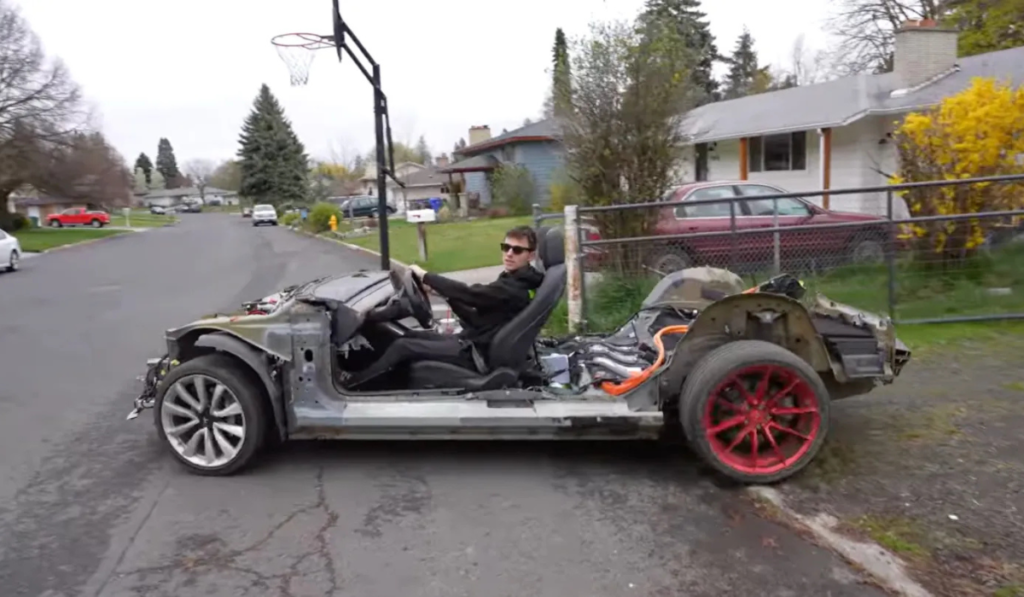
A YouTuber managed to snag a completely stripped Tesla Model 3 for only $2,000 — missing body panels, windshield, and seatbelts — and still managed to take it off-roading, drifting, and even airborne. The most surprising detail? The battery still showed a 212-mile range when fully charged.
The video, uploaded by Remmy Evans, is both a tribute to Tesla’s rock-solid drivetrain engineering and the kind of chaotic creativity that keeps YouTube endlessly watchable.
How a Failed Project Became a $2,000 Go-Kart
It all started with a phone call. Evans heard from his friend Jake about an unusual vehicle sitting at Jake’s brother-in-law’s place in Idaho — a Tesla Model 3 gutted down to its bare frame. The previous owner, Grayson, had originally bought the car for somewhere between $6,000 and $7,000, planning to pull the drivetrain and drop it into a 1970s concept car. They even commissioned a 3D artist to visualize the final build and began fitting components — but ultimately walked away after calculating the bodywork alone would demand around 800 hours of labor.
Evans talked the asking price down from $3,000 to $2,000, driving away with what amounted to a rolling Tesla skeleton — motors, battery, screen, seats, and steering wheel intact, but no windshield, no exterior panels, and no safety belts. The car had been sitting unregistered for over two years.
Tesla drivetrains have quietly become a favorite among custom builders and classic car restorers. Companies like EV West even sell Tesla crate motors designed specifically for swap projects. Most people pull the drivetrain out and put it into something else — Evans just decided to drive whatever was left.
212 Miles of Range, 78 Error Codes
Evans swapped out the original tires — which were falling apart down to the wire — for a fresh set mounted on bright red wheels, then charged the car to full. The range display read 212 miles, which is remarkable for a vehicle in this condition.
The software side of things was a different story. The car was generating 78 active error codes, a predictable result when Tesla’s system goes looking for cameras, sensors, and safety hardware that simply no longer exist. Interestingly, because the previous owner had disabled all safety sensors, the car’s drift-lock feature was also unlocked — something Tesla’s Track Mode usually keeps tightly controlled.
Evans fastened a DOT-rated ratchet strap as a DIY harness and did exactly what most people wouldn’t dare: he drove the stripped-down Tesla 25 minutes on public roads to a Best Buy — without a single police encounter — before taking it out to drift, go off-road, and launch it over a dirt jump on a friend’s property. His friend Drew summed it up as feeling like a Polaris Slingshot, but significantly faster.
Charging Turned Into Its Own Ordeal
Keeping the car charged was an adventure in itself. On the first night, Evans pulled up to a DC fast charger only to find his adapter was incompatible. His fix: a quick trip to Harbor Freight, where he literally sawed the top off a charging adapter to force it to fit, then wedged something into the charger handle to keep the connection alive. It held — barely.
A bigger issue surfaced later. Evans and a friend who owns a standard Model 3 realized that CCS fast charging — the standard protocol for most public DC fast chargers — might not even be activated in the stripped car’s software. Turning it on would mean running a software update, but Evans was worried that an update might cause the car to detect all its missing components and shut down entirely. Without fast charging, the car needs seven to eight hours on a Level 2 charger, or more than fourteen hours plugged into a standard 110V home outlet.
Tesla’s Software Isn’t Going Down Without a Fight
To avoid triggering an update, Evans steered clear of any software changes — but once he connected the Tesla app to the vehicle, the car started throwing up “Service Required” alerts and became increasingly stubborn to operate.
This is a pattern well-known among salvage rebuilders and heavy modifiers of Tesla vehicles. Tesla’s over-the-air update system and deeply embedded software means the car is always checking on its own hardware. When key safety components go missing, the software starts locking things down — a sensible safety measure that nonetheless creates real friction for anyone trying to do unconventional things with these cars.
Evans closes the video hinting at a Part 2, where he plans to roll the stripped Tesla into an official Tesla service center about 40 minutes from his home in Washington state. Whatever happens, it’s bound to be entertaining. Tesla will likely charge a significant inspection fee just to assess whether the car qualifies for fast charging — or they may simply take one look at it and say no outright.
The Bigger Picture
This video is entertaining on the surface, but it quietly makes a serious point about electric vehicles: the drivetrain is the most resilient part of the whole machine. Strip away everything else — the panels, the glass, the safety systems — and the motors and battery pack just keep going. That’s the core promise of EVs — fewer moving parts means fewer points of failure. Tesla drivetrains have survived floods, crashes, and years of neglect. This one survived becoming a go-kart.
Pingback: Honda Civic vs. Accord vs. CR-V: Which is safest? - evautoindustry.com