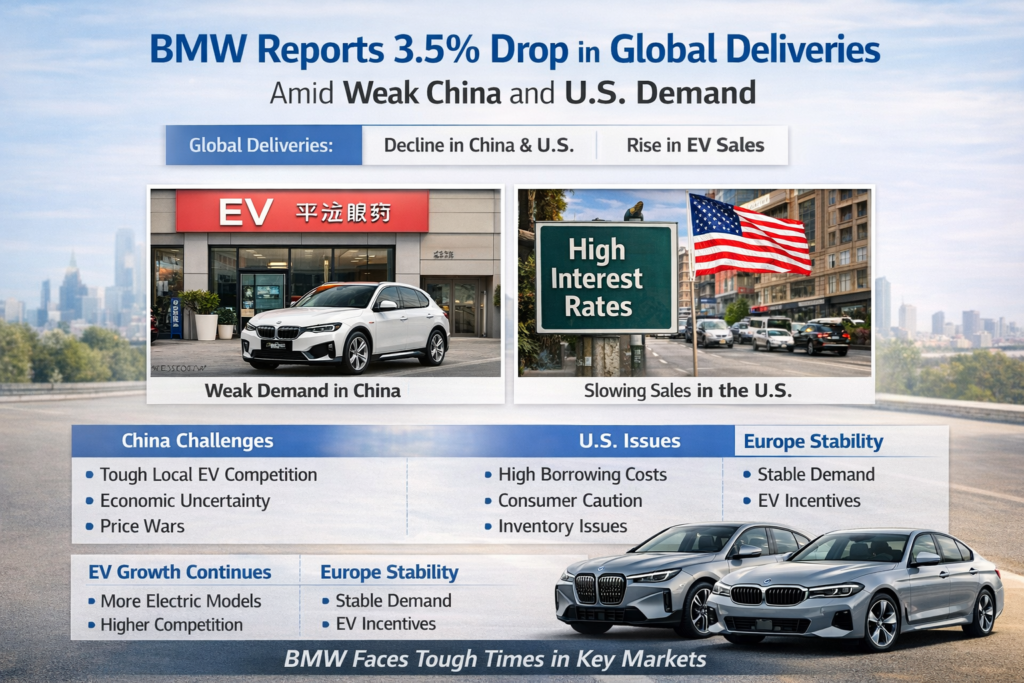
BMW has reported a 3.5% decline in its global vehicle deliveries, reflecting growing pressure in two of its most critical markets—China and the United States. The latest data signals a shifting landscape for the premium car segment, where demand is becoming more volatile due to economic uncertainty, changing consumer preferences, and the rapid rise of electric vehicles.
Key Highlights of BMW’s Delivery Report
BMW’s recent performance shows a noticeable slowdown compared to previous growth trends. The company delivered fewer vehicles globally, with declines concentrated mainly in China and the U.S., which together account for a large share of its revenue.
Main Points
- Global deliveries declined by 3.5% year-on-year
- Weak consumer demand in China significantly impacted overall numbers
- U.S. market also saw slower sales due to high interest rates and cautious spending
- European sales remained relatively stable, helping offset some losses
- Electric vehicle sales continued to grow but not enough to balance total decline
Weak Demand in China: A Major Concern
China remains the largest automotive market in the world, and any slowdown there directly affects global automakers. BMW faced reduced demand as economic growth slowed and local competition intensified.
Factors Behind the Decline
- Rising competition from domestic EV brands
- Changing consumer preference toward affordable electric vehicles
- Economic uncertainty affecting luxury purchases
- Price wars among automakers reducing margins
Chinese brands are rapidly gaining market share, particularly in the EV segment, making it harder for traditional premium players like BMW to maintain dominance.
U.S. Market Challenges Continue
The U.S. market also contributed to BMW’s decline, although for different reasons. High borrowing costs and inflation have made consumers more cautious about purchasing luxury vehicles.
Key Issues in the U.S.
- Higher interest rates increasing auto loan costs
- Reduced consumer confidence in big-ticket spending
- Growing competition from both legacy and EV-focused brands
- Inventory adjustments affecting delivery timing
Despite these challenges, BMW still maintains a strong brand presence in the U.S., especially in the luxury SUV and sedan segments.
Electric Vehicles: Growth but Not Enough
BMW continues to invest heavily in electric mobility, and its EV lineup has shown steady growth. However, the pace of EV adoption has not yet compensated for the decline in traditional internal combustion engine vehicle sales.
EV Strategy Overview
- Expansion of electric models across multiple segments
- Focus on premium EV experience and performance
- Increasing production capacity for electric vehicles
- Competition intensifying from brands offering lower-priced EVs
While EVs are a long-term growth driver, the transition phase is creating short-term delivery fluctuations.
Europe Offers Some Stability
Unlike China and the U.S., Europe has provided relatively stable demand for BMW. The region’s consistent interest in both luxury and electric vehicles has helped cushion the overall decline.
Why Europe Remains Stable
- Strong demand for premium vehicles
- Government incentives supporting EV adoption
- Established brand loyalty for BMW
- Balanced market conditions compared to China and the U.S.
What This Means for BMW’s Future
BMW’s 3.5% drop in deliveries highlights the challenges facing global automakers in 2026. The company must navigate a complex mix of economic pressures, technological shifts, and regional differences in demand.
Future Outlook
- Continued focus on electrification and innovation
- Potential pricing adjustments to remain competitive
- Increased localization in key markets like China
- Strategic investments in next-generation mobility solutions
BMW is expected to adapt its strategy to align with evolving market conditions while maintaining its premium positioning.
also read Kia Sorento Hybrid India Launch Expected in October 2026 Price Features and Full Details
Conclusion
The recent decline in BMW’s global deliveries underscores a broader transformation within the automotive industry. Weak demand in China and the U.S. has exposed vulnerabilities even for established luxury brands. However, with ongoing investments in electric vehicles and steady performance in Europe, BMW remains well-positioned to navigate the challenges ahead.
FAQ
Why did BMW’s global deliveries decline?
BMW’s deliveries dropped mainly due to weak demand in China and the United States, along with economic pressures and increased competition in the EV segment.
How much did BMW deliveries fall?
Global deliveries declined by approximately 3.5% compared to the previous year.
Is BMW losing market share in China?
BMW is facing increased competition from domestic Chinese EV manufacturers, which is impacting its market share.
Are BMW electric vehicles performing well?
BMW’s EV sales are growing, but not at a pace sufficient to offset the decline in traditional vehicle sales.
Which region is performing best for BMW?
Europe remains the most stable region for BMW, with consistent demand for both luxury and electric vehicles.